A curriculum committee approves a new fire science program. The course catalog is written, the adjunct instructors are lined up and the first cohort starts in August. Then someone asks where the students will actually pull a hose line.
Equipment is often the last piece of a new program to come together, and it is the hardest to change once it arrives. Accreditors, certifying bodies and prospective students all judge a program by the same thing: whether its graduates can perform a skill, not just describe it. That makes the equipment list one of the most consequential decisions a new program makes in its first two years.
What Accreditation Standards Actually Ask Equipment to Do
Standards rarely name equipment. They name performance. The job performance requirements for Firefighter I and II now sit in NFPA 1010, the 2024 consolidation of NFPA 1001 and several related qualification standards. They describe what a candidate must demonstrate, and the certifying bodies accredited through IFSAC or the Pro Board test to them. Most of those bodies are expected to fully align with NFPA 1010 by 2027. A program launching now should build its skills labs around the new standard rather than the old one.
Live fire has its own rulebook. NFPA 1403, the long-standing standard on live-fire training evolutions, has been folded into the 2026 edition of NFPA 1400, Standard on Fire Service Training. Its requirements for instructors, safety officers, burn plans and structure inspection shape how often a program can realistically run live fire. For most new programs, that is less often than the curriculum would like.
On the EMS side, paramedic programs need CAAHEP accreditation through CoAEMSP before graduates can sit for the National Registry exam. Programs at every level also have to verify psychomotor competency against the National EMS Education Standards. Lifting, moving and extricating patients are part of that, and none of it can be verified on a whiteboard.
Read together, the standards ask equipment to do three things:
- Let students perform a job performance requirement themselves, rather than watch an instructor demonstrate it
- Allow the same skill to be repeated until competency is documented
- Support live-fire evolutions that can be run within NFPA 1400 safety requirements
A new program that buys against those three tests will rarely buy the wrong thing.
How Digital and Live Fire Training Work Together in a Curriculum
Debating digital against live fire misframes the question for a new program. The real question is sequence.
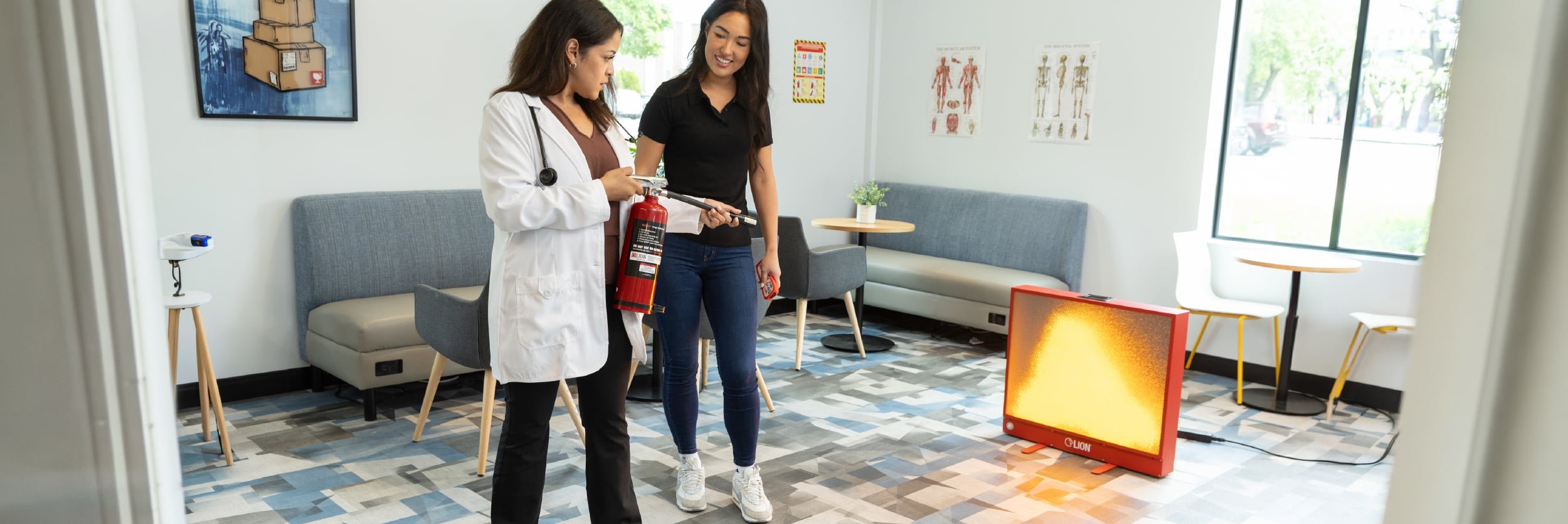
Early in a curriculum, students are learning fundamentals: nozzle operation, stream selection and reading how fire responds to water. Live fire at that stage is slow and costly, and much of each evolution goes to managing risk rather than coaching technique. The ATTACK™ Digital Fire Training System is built for that stage. It uses LED flames that respond to where and how water strikes the panel, across Class A, B and C settings. It also works with a digital nozzle and weighted hose line. Paired with the SG4000™ Smoke Generator, it adds the low visibility students will face on the fireground.
QuickFire® covers extinguisher fundamentals. A headset and a prop extinguisher place students in virtual reality scenarios that instructors manage from an app. The system runs on its own battery and involves no water or chemicals. It fits naturally into introductory fire science courses, fire prevention and public education coursework, and vocational certificate programs where extinguisher use is the end goal rather than the starting point.
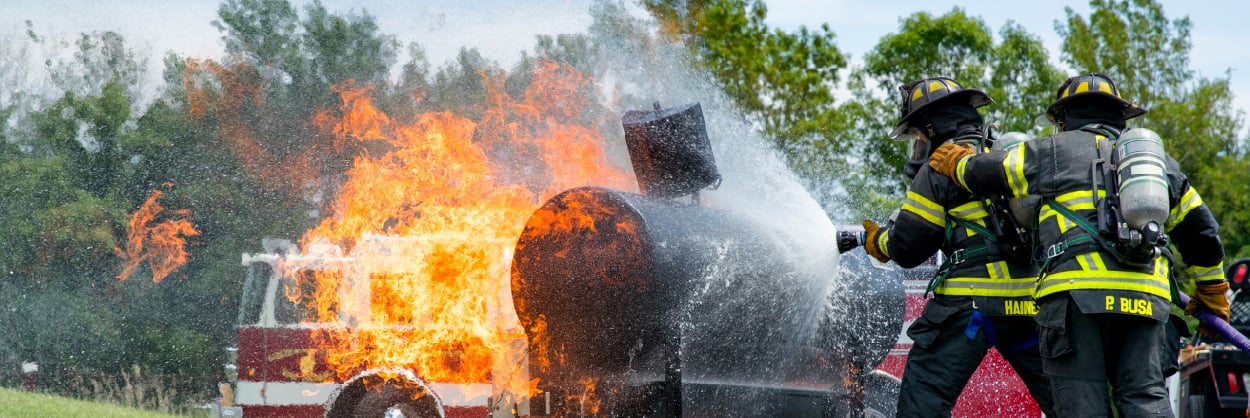
Live fire comes next, and it counts for more when students arrive prepared. LION’s Live Fire Training Props burn propane under instructor control, so an evolution can be stopped the moment a student's technique breaks down and restarted once it is corrected.
The division of labor is simple: Digital builds the technique, and live fire validates it under real heat. Students who reach the burn with dozens of digital reps behind them spend their live-fire time on decision-making instead of basic nozzle control.
Getting the Most Repetitions Per Budget Dollar
Purchase price is the wrong number to compare. The useful figure is cost per quality repetition over the life of the equipment. For live fire, each rep carries fuel, SCBA cylinder refills, water, staffing for the evolution, cleanup and turnaround time between students.
Measured that way, the equipment sorts itself. Digital systems have almost no marginal cost. They reset in seconds, run in a classroom or apparatus bay, and let one instructor cycle an entire lab section through in a single period. Propane props carry a fuel cost but deliver far more evolutions per training day than a Class A burn, with no debris and instant start and stop. Structures cost the most, but they deliver the kind of repetition nothing else can: interior attack, search and ventilation in a real building.
SmartDummy™ Rescue Manikins may be the strongest value on the list. They come in 55-pound and 110-pound configurations for drags, carries, stair evacuations and search. Each rep costs nothing beyond instructor time. They also cross the curriculum line: the same manikin serves a fire science rescue lab in the morning and an EMS patient-movement lab in the afternoon, so an institution running both programs spreads one purchase across two budgets.
Phasing Equipment Purchases as Enrollment Grows
New programs rarely know their true enrollment until the second or third cohort. Buying for the program you hope to have locks capital into equipment that may sit idle. Buying for the smallest possible program leaves students without the reps the standards require. Phasing solves both problems.
Phase one, at launch. Portable, indoor, multi-use equipment such as the ATTACK system, QuickFire, SmartDummy manikins and a smoke generator. This covers fundamentals, works in existing classroom and bay space, and moves with the program if it relocates.
Phase two, as the first cohorts fill. Live-fire capability. The Hose Line Training System starts with a burn tray, pilot module and control console. From there, programs add modular props such as a fuel spill or electric motor fire as funding becomes available, without replacing the base system.
Phase three, once enrollment is established. A dedicated structure. LION Training Structures range from containers and roll-offs to fixed towers and multi-building complexes. TrainingReady™ Units offer a modular step before a full burn building.
Nothing from an earlier phase gets retired. The digital panels become the pre-burn warm-up station, and the manikins move into the structure for search drills. Programs in career and technical education can often draw on Perkins V funding for early phases. A shared-use agreement with a local fire department can help justify the later ones.
How Equipment Choices Shape Program Competitiveness
A new program competes for students against established academies and community colleges that already have burn towers. Prospective students and their families tour the facility, and equipment is the most visible evidence of what the program actually delivers.
Outcomes matter even more. CoAEMSP-accredited programs report retention, credentialing exam pass rates and job placement every year. Fire departments recruiting from a program look closely at its certification results. Programs that give students more hands-on reps tend to see it in their psychomotor exam performance, and those results show up in recruiting conversations.
Equipment also opens partnerships. Many local departments lack modern training resources of their own. A program with current props can become a regional training site, which brings rental revenue, instructor relationships and a hiring pipeline. Departments tend to hire graduates they have already trained alongside.
Frequently Asked Questions
What training equipment supports fire science and EMS accreditation standards?
Equipment that lets students perform job performance requirements repeatedly until competency is documented. For fire science, that means digital and live-fire suppression systems aligned to NFPA 1010, run within NFPA 1400 safety requirements. For EMS, that means rescue manikins that support the psychomotor skills verified under the National EMS Education Standards.
How do digital and live-fire training complement a new curriculum?
They work in sequence. Digital systems build nozzle technique and fire behavior recognition at low cost and with no risk, and live fire validates those skills under real heat. Students who reach live fire already prepared get more out of each burn.
What equipment gives students the most repetitions per budget dollar?
Digital fire systems and rescue manikins, because each additional rep costs almost nothing. Propane-fueled live fire props come next, delivering far more evolutions per day than Class A burns. Compare equipment by cost per repetition over its life, not by purchase price.
How can institutions phase equipment purchases as enrollment grows?
Start with portable, multi-use equipment at launch. Add a modular live fire system as cohorts fill, then invest in a dedicated training structure once enrollment is established. Equipment from each phase stays in use as the program grows.
How does equipment choice affect program competitiveness and enrollment?
Equipment is what prospective students see on a tour, and it drives the certification outcomes that departments weigh when they recruit. Modern training equipment also positions a program as a regional training site, which builds department partnerships and hiring pipelines.
Related posts
Popular posts