Most people know the Clery Act as the federal law that requires colleges and universities to publish campus crime statistics. Institutions with on-campus student housing have another reporting obligation, though: an annual fire safety report.
That report covers fire statistics, drills, policies, logs and training programs. The fire safety half of Clery receives far less attention than the crime statistics half, but it is also where a thin training program stops being an internal practice and becomes a published federal disclosure.
What the Annual Fire Safety Report Actually Requires
Any institution that maintains on-campus student housing must publish an annual fire safety report by October 1 under 34 CFR 668.49. At minimum, that report has to contain several specific items:
- Fire statistics for each on-campus student housing facility
- A description of each facility’s fire safety system
- The number of fire drills held during the previous calendar year
- Institutional policies on portable electrical appliances, smoking and open flames in student housing
- Procedures for evacuating student housing in the event of a fire
- The policies regarding fire safety education and training programs provided to students and employees
That last item deserves a second read. Your training program is a disclosable item. You are describing it in writing to the Department of Education and to every prospective student and employee who opens the report. An institution running a substantive program gets to say so. An institution sending one email in September gets to say that instead.
A separate obligation runs alongside the report. Institutions with on-campus student housing must keep a written, easily understood fire log recording the nature, date, time and general location of every fire in those facilities. Entries go in within two business days. The most recent 60 days stay open for public inspection, and anything older has to be produced within two business days of a request.
Clery Does Not Set Your Drill Schedule
The most common misreading of the regulation is that Clery sets the drill schedule. In fact, Clery requires you to disclose how many drills you held during the previous calendar year. It says nothing about what that number ought to be.
Frequency comes from your fire code and your authority having jurisdiction. Under the International Fire Code, college and university residential buildings fall under Group R-2 and require four drills per year with all occupants participating. States add their own terms on top.
So there are two obligations, not one, and they get conflated constantly. Hit the number your code requires, then report the number you actually hit. Reporting a number you did not hit is a Clery problem. Missing the number your code requires is a fire marshal problem. Different enforcers, and both of them can come after you.
What Counts as a Fire Drill Under the Regulation
The regulation defines a fire drill as a supervised practice of a mandatory evacuation of a building for a fire. Three words in that definition carry the weight.
Supervised means somebody is running it and watching what happens. Mandatory means occupants are required to leave rather than invited to. Evacuation means they actually left the building. An alarm that sounds while half the hall waits it out upstairs does not comfortably meet that definition, and the resulting count is a number you are certifying to the federal government.
Which makes this a training question before it is a scheduling question. Residents comply when somebody has explained why it matters. Staff enforce the evacuation when they understand it is their job.
Standardizing Training Across Residence Halls and Departments
A campus is a federation. Residence life, facilities, environmental health and safety, campus police, dining and academic departments each train their own people and report up different chains. Clery reporting pulls all of it into one document with one signature.
Turnover makes that harder than it sounds. Resident advisors turn over every year, sometimes every semester. The resident population turns over annually. Facilities staff have much lower turnover rates. The same content has to reach three audiences on three different refresh cycles, which is why campus training tends to drift building by building.
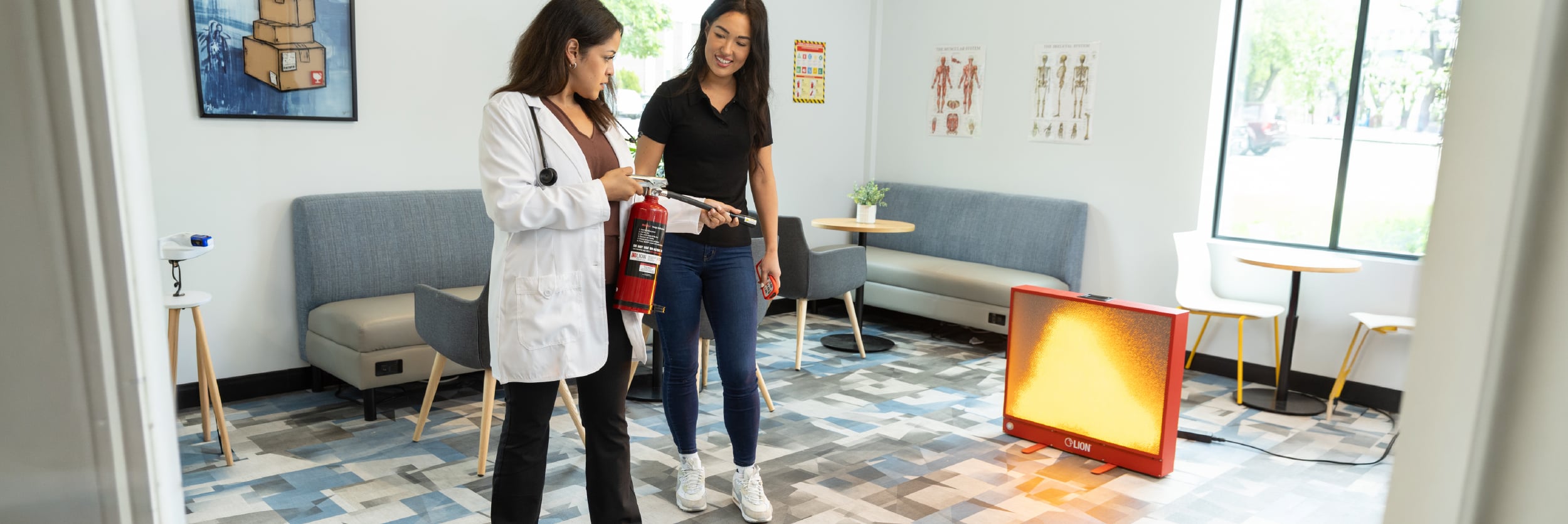
Extinguisher training is where that drift is most visible and most fixable. The BullsEye™ Digital Fire Extinguisher Training System uses laser-driven extinguishers and LED flames to mimic a real fire, and the flames only go out when a trainee applies correct PASS (Pull, Aim, Squeeze, Sweep) technique. It runs indoors with no discharge and no cleanup, and it resets in seconds, so it works at a residence hall event or a staff onboarding rather than requiring a scheduled outdoor session.
Institutions running fire science, EMS or public safety programs—or operating their own training site—often go further with TrainingReady™ Units, container-based systems with moveable walls and interchangeable props that support live fire, confined space and search scenarios in one footprint.
Documentation Gaps That Create Compliance Risk
The failures that surface in program reviews are rarely dramatic. They are almost always records that were never consolidated.
- Drill counts held by individual hall staff and never gathered before the October 1 deadline
- Training sessions with no attendance record, which cannot support the education and training disclosure
- Fire log entries added outside the two-business-day window
- Inconsistent definitions between buildings, where one hall counts an alarm activation as a drill, and another does not
- Statistics reconstructed from memory in September rather than logged as events happened
The stakes are not abstract. The Department of Education can impose civil penalties per violation, adjusted annually for inflation, and fire safety findings such as failing to maintain a fire log or publish the required report appear in program reviews alongside the crime statistics failures that get more press.
One more thing worth knowing. The 265-page 2016 Handbook for Campus Safety and Security Reporting was rescinded and is now labeled for historical purposes only. Current official guidance is the much shorter Clery Act Appendix for the FSA Handbook, which quotes the statute and regulations and leaves institutions more interpretive room. Plenty of campus compliance material still treats the old handbook as binding.
How Structured Training Supports the Annual Security Report
The annual report is an output. Every number and policy statement in it comes from records generated during the year by people who were not thinking about October 1 at the time.
A program that logs participation as training happens produces three things at once. It supplies the education and training disclosure with something specific to describe. It backs the drill count with evidence that the drills were supervised and that people left the building. And it gives the Clery coordinator a source to work from in September instead of a round of emails asking hall directors what they remember.
Build the record during the year and the report mostly writes itself. Build it in September and you are documenting what you can reconstruct, which is a different thing from what happened.
Frequently Asked Questions
What fire-safety training documentation does Clery Act compliance require?
The annual fire safety report must disclose your policies on fire safety education and training programs for students and employees. It also must include the number of fire drills held the previous calendar year, evacuation procedures, housing policies on appliances, smoking, and open flames, a description of each facility’s fire safety system, and fire statistics. Institutions with on-campus housing must also maintain a fire log with entries made within two business days.
How often must fire drills and training be conducted and recorded?
Clery requires you to report the number of drills held, not to hold a particular number. Frequency comes from your fire code and local authority. The International Fire Code requires four drills per year with all occupants participating in Group R-2 college residential buildings, and state law may require more or set specific timing.
How can campuses standardize training across residence halls and departments?
Use training equipment that works indoors and resets quickly, so the same session can run at a hall event, a staff onboarding and a departmental refresher without rescheduling around an outdoor site. Then apply one definition of what counts as a drill across every building, and log participation centrally as it happens.
What are common documentation gaps that create compliance risk?
Drill counts kept locally and never consolidated, training with no attendance record, fire log entries made late, inconsistent drill definitions between buildings, and statistics reconstructed from memory before the deadline rather than recorded as events occurred.
How does structured training support the broader annual security report?
The report is assembled from records created throughout the year. Training that logs participation as it happens gives the Clery coordinator specific material for the education and training disclosure, evidence supporting the drill count, and a documented source to draw from instead of reconstructing the year from memory.
Related posts
Popular posts

.jpg)