Fire departments don’t struggle with commitment. They struggle with time.
Rotating instructors, compressed training windows, limited facilities, aging props and operational demands make it difficult to deliver consistent training. What gets practiced often depends less on a standardized plan and more on what’s available that day.
This leads to large variables in training. And variability makes readiness hard to measure.
To build measurable readiness, departments need a model that works within short windows, supports instructor consistency and validates performance in a deliberate way.
Why Consistency Breaks Down in Real-World Environments
Even well-designed training programs can drift over time.
An experienced instructor retires or a facility becomes unavailable. A prop is down for maintenance or a shift runs short-staffed. Eventually, training programs start to shift and evaluation standards change. Fundamentals are emphasized differently depending on who is leading the evolution.
This inconsistency creates three challenges:
- Repetition becomes irregular.
- Scenario difficulty fluctuates.
- Performance comparison becomes unreliable.
Without standardized scenario design and evaluation, it becomes difficult to answer critical questions:
- Are firefighters improving over time?
- Are fundamentals executed consistently?
- Are weaknesses systemic or isolated?
Departments need a training model that removes dependency on variables they can’t control.
What a Standardized Blended Model Looks Like
Blended training doesn’t mean mixing formats randomly. It means intentionally designing a cadence that balances repetition, realism and validation.
A practical blended model includes:
Frequent Digital-Based Decision-Making and Fundamentals Reps
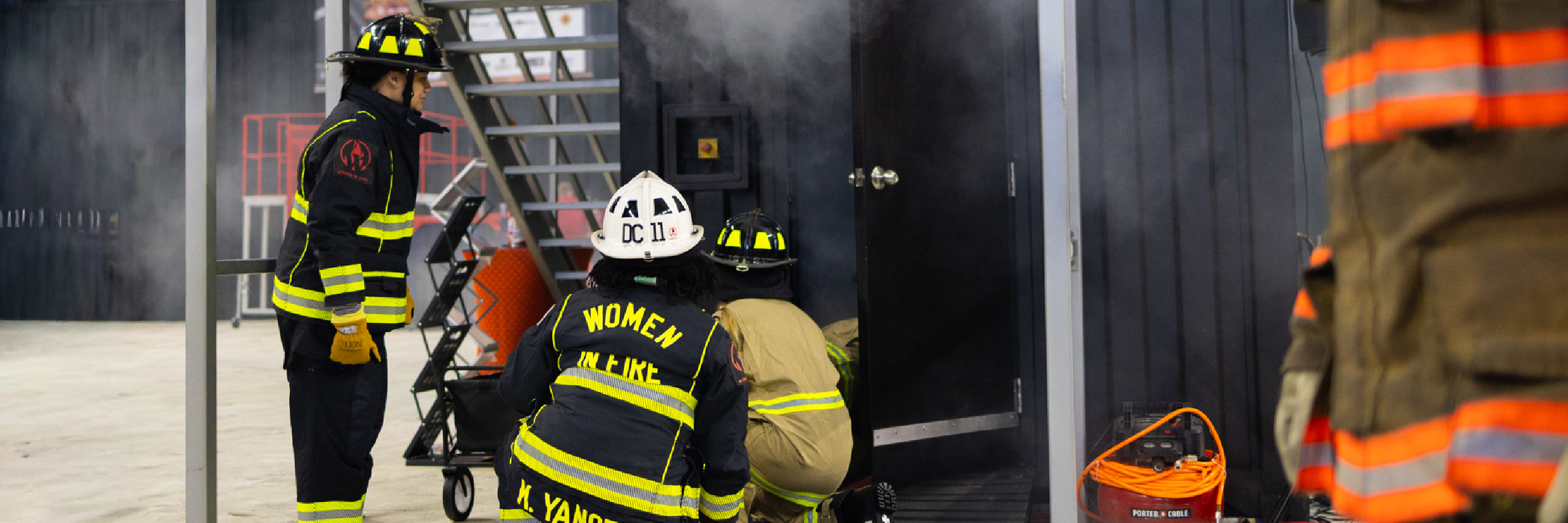
Immersive digital training allows firefighters to practice their skills, communication and decision-making in short, controlled windows. Using solutions like LION’s ATTACK™ Digital Fire Training System, departments can run realistic scenarios indoors in minutes, without needing full burn setups or extensive prep.
Targeted, Controlled Live-Fire Validation
Live-fire training remains essential. Heat, smoke and unpredictability test execution in ways simulations cannot.
But without a deliberate cadence and controlled systems, live-fire training becomes resource-heavy and difficult to run consistently. Live-fire training systems and props are designed to provide repeatable, controlled burn environments that reduce setup complexity while maintaining realism.
Instead of using live fires for every repetition, departments can use them for targeted goals:
- Confirming fundamentals
- Evaluating team coordination
- Stress-testing decision-making under real conditions
Standardized Scenario Design and Evaluation
Consistency requires more than consistent equipment; it requires consistent measurement.
Departments should define:
- Clear scenario objectives
- Observable performance criteria
- Scoring methods that remain constant across instructors
- Documented remediation pathways
When evaluation standards are aligned across live-fire environments, performance becomes comparable. Leaders can track score trends over time, identify recurring skill gaps and measure time-to-proficiency for new recruits.
Training shifts from anecdotal feedback to measurable readiness.
Making Short Windows Count
Most departments don’t have full-day blocks for training. They have short windows between calls, compressed academy schedules and rotating shifts.
Blended training allows those windows to be productive. A digital session can be deployed quickly, repeated across shifts and reset in minutes. Products like fire training containers provide consistent training environments without requiring new facilities to be built.
Infrastructure Reliability and Uptime
Training continuity depends on equipment reliability.
Aging props, extended maintenance downtime and inconsistent facility access reduce available training opportunities. Over time, this erodes cadence and limits repetition.
Modular infrastructure and proactive maintenance planning help departments maximize uptime. When systems are designed for durability, repeatability and ease of deployment, instructors can focus on training instead of troubleshooting.
Quantifying Measurable Readiness
Leaders need to justify investment in training with more than anecdotal improvements.
Clear indicators of measurable readiness include:
- Reduced time-to-proficiency for recruits
- Upward score trends across repeated scenarios
- Lower remediation rates over time
- Improved consistency across shifts
- Reduced training-related risk exposure
When departments can demonstrate improvement in these areas, training investments become defensible.
Instead of saying, “We trained more,” leaders can say, “Our teams are more prepared. And we have the numbers to prove it.”
That distinction matters to city officials, procurement leaders and stakeholders responsible for funding decisions.
Building a Repeatable, Sustainable Model
Blended fire training is not about replacing live fires or adopting technology for its own sake. It’s about building a repeatable system that protects firefighters and strengthens readiness within real-world constraints.
By combining digital training systems, live-fire exercises, modular infrastructure and standard evaluations, fire departments can maintain consistency even when time is short and variables shift.
And leaders can gain the clarity they need to prepare their teams for whatever comes next.
Common disruptions include:
- Staffing shortages that limit availability
- Unexpected incidents or emergencies
- Production or service demands that take priority
- Competing internal priorities or projects
When these disruptions occur, training is often the first thing to be rescheduled. This can create gaps between sessions—and those gaps can reduce retention and weaken consistency.
Related posts

Popular posts

.jpg)